

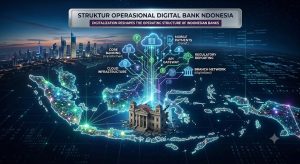
The digital transformation taking place across Indonesia’s banking industry is not only changing how customers conduct transactions but is fundamentally reshaping how banks operate, manage resources, develop products, and build relationships with customers.
A decade ago, a bank’s success was often measured by the number of branches and ATMs it owned. By 2026, however, key performance indicators have shifted toward the number of active digital users, electronic transaction volumes, digital customer experience quality, and the ability to leverage data as a strategic asset.
This transformation marks the beginning of a new era for Indonesia’s banking industry, where technology serves as the foundation of business operations.
Digitalization is no longer viewed as merely an information technology project. Instead, it has evolved into a comprehensive organizational transformation strategy encompassing people, processes, corporate culture, business models, and governance structures.
A Paradigm Shift in Banking Operations
Before the digital era, most banking activities were conducted through physical branches. Customers were required to visit a branch in person to:
- Open accounts
- Deposit funds
- Apply for loans
- Update personal information
- Obtain account information
- Submit complaints
This operating model required:
- Extensive branch networks
- Large numbers of front-line employees
- Significant physical infrastructure
- High operating costs
Today, most of these activities can be performed through a smartphone. This transformation has forced banks to redesign their entire operating model.
The banking business model is shifting from a branch-centric approach to a digital-centric approach. Previously branches served as the primary service center. Today digital applications serve as the primary service center. Branches are increasingly being transformed into:
- Advisory Centers
- Wealth Management Centers
- Business Banking Centers
- Customer Experience Hubs
Rather than serving as the main location for routine transactions. Major Indonesian banks have begun optimizing their branch networks. The objective is not merely cost reduction but adapting to changing customer behavior. Many activities that once dominated branch transactions have now migrated to digital channels, including:
- Fund transfers
- Bill payments
- Mobile top-ups
- Account opening
- Credit card applications
- Investment services
As a result, branch visit volumes have declined significantly.
Mobile Banking Becomes the New Branch
Mobile banking applications now function as digital branches. Customers can perform nearly all financial activities without interacting directly with bank personnel. Examples include:
- myBCA – integrates various BCA products and services
- BRImo – combines banking, investment, and payment services
- Livin’ by Mandiri – has evolved into a financial and lifestyle super app
- Wondr by BNI – delivers a more personalized digital banking experience
Applications have become the primary point of interaction between banks and customers. One of the most significant impacts of digitalization is the increased use of automation. Robotic Process Automation (RPA) is now being utilized to replace various administrative tasks.
Customer Data Verification previously performed manually. Now it is automated using OCR and AI technologies. Account Opening can now be completed within minutes. Loan Document Verification largely automated. Internal Reporting generated automatically and in real time. The benefits are substantial:
- Reduced human error
- Faster processing times
- Lower operating costs
- Improved service quality
Digitalization has fundamentally transformed the operating structure of Indonesia’s banking industry. This transformation encompasses technology, business processes, human resources, and business models as a whole. Banks that successfully adapt will achieve higher efficiency, superior customer experiences, and stronger competitiveness in the digital economy.
Conversely, institutions that fail to transform risk falling behind in an increasingly technology-driven marketplace. The year 2026 marks a pivotal milestone in Indonesia’s transition toward a smarter, more efficient, and future-oriented digital banking operating model.
Editor: Rachmat Adhani (Business Development Manager Ocean Innovation)


